
MYP & DP policy
Language.
Many languages, one community.
Language is at the heart of identity and culture. It is how we view, think about, communicate with and learn about the world.
Download PDFEvery student’s mother tongue matters, and it is supported at school while they learn other languages.
Multilingualism is central to international-mindedness. Through Language Acquisition, every student learns at least two languages: English and one other. Because English is our main language of communication, all subject teachers are language teachers, so students grow in English across every subject.
How this links to other policies
- Admissions: families tell us which languages their child understands and speaks.
- Inclusion: students learning English as a second language take an English test so we can plan extra support. Parents share evidence of any learning or physical needs so we can arrange support permitted by the IB.
- Assessment: language skills are checked at admission, and formative and summative assessments are held in the language each student chooses for Language Acquisition.
Our language profile
Our community is mainly Indian and non-resident Indian. Most students speak Tamil at home, followed by Telugu and Malayalam, with a small number from other language backgrounds, and a very small number of Korean nationality. English is the main language of teaching and conversation at school.
Parents value the school’s role in building strong English while they keep up their child’s home language. Nearly all our students are bilingual, and 60% speak three languages.
Languages at The Pupil
- English is the language of instruction across all our IB programmes, except in Language Acquisition, where the target language is used with English as support.
- Outside the classroom, students and teachers are free to talk in the language of their choice.
- In the MYP and DP, students build thinking, reasoning and communication mainly in English, while Language Acquisition builds fluency in another language.
- School events bring in Tamil, French and Hindi through translation, interpretation and language activities.
- Every applicant takes a language test in English and a second language, so we can give the right support.
- Students are encouraged to keep the same language choices. Any change is discussed with parents first.
Language options
| Programme | First language | Second language |
|---|---|---|
| PYP (Forms 1 to 5) | English | Tamil, Hindi, French |
| MYP (Forms 6 to 10) | English (Language and Literature) | Hindi or French (Language Acquisition), with Tamil support sessions |
| DP (Forms 11 and 12) | English A: Language and Literature (SL or HL) | French B (SL) or French ab initio |
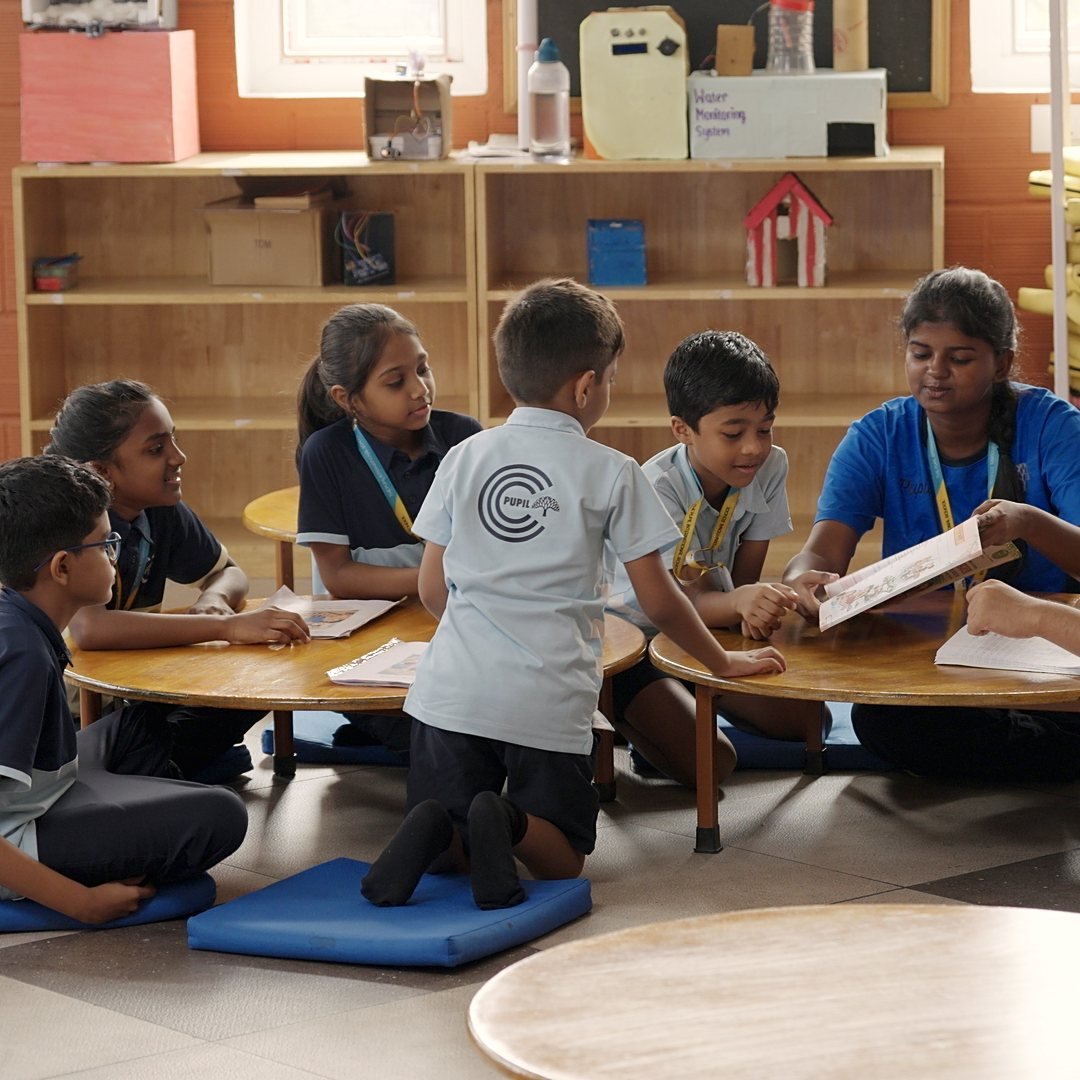
In the PYP, students develop literacy in English through transdisciplinary learning, and learn two other languages from Tamil, Hindi and French. In the MYP, Tamil sessions are offered alongside the curriculum to strengthen the state language. In the DP, Group 1 and Group 2 are both required for the IB Diploma.
DP students who studied French in Forms 9 and 10 are placed in French B (SL) or French ab initio based on their level. Students new to French may take French B (SL) if they score above 60% in the language test.
Language in practice
- We support language development in a student-centred way, across every part of language learning.
- Language helps students understand different cultures and work well in a multicultural classroom.
- We offer as many languages as practically possible, with active teaching and support.
- Language learning, especially in the MYP, is matched to each student at emergent, capable or proficient level.
- Our Bring Your Own Device policy supports listening, speaking, reading and writing activities.
Languages and culture
- Independence Day: performances in different languages that show India’s linguistic diversity.
- Hindi Diwas: poetry, drama and celebrations of Hindi writers.
- Bharathiyar Day: a tribute to the great Tamil poet, reformer and freedom fighter, Mahakavi Subramania Bharathiyar.
- French Language Day: skits, songs and speeches in French.
Commentary for Annual Day and Sports Day may be in Hindi, Tamil and English, and French is used in skits, songs and narration.
Support for English learners
- Dictionaries, online and offline.
- An English as a Second Language section in the library, with dictionaries, books, video and audio.
- Set time for reading, writing, viewing and presenting in English.
- A plan, led by English teachers with subject teachers, that builds the language each subject needs.
- Practice sheets and resources to build vocabulary.
- A buddy system that pairs them with first-language English speakers.
- Differentiated work, peer learning in mixed groups, and extra time when needed.
Support materials include magazines, newspapers and short stories in different languages, and Hindi, Tamil, French and Korean dictionaries.
The library
The library is central to language at The Pupil and a place that celebrates all languages. Kindergarten classrooms have their own library corners, and the main library holds fiction, non-fiction, multicultural books, world classics, reference books, and books in English, Tamil, Hindi and French, with a growing collection of bilingual and regional-language books and digital resources.
The student government runs events such as author week and poetry month, including short skits linked to Language and Literature and Language Acquisition.
Parents and community
Parents play a key part in language learning. They are encouraged to follow their child’s progress, attend parent-teacher-student meetings, and take part in guest lectures and events.
Teacher development
- Training for all teachers on text forms.
- Training on reading and writing strategies.
- Subject teachers work with language teachers to build language into their lessons.
Mother tongue
Teachers who are more fluent in their mother tongue are trained to teach in English, and may use their mother tongue with students when it helps. No student or teacher is ever disciplined for using their mother tongue. In class, it is used as a support language, so that it does not hold back fluency in English.
Festivals and morning assemblies are held in English, Hindi and the regional language.
Policy review
The Language Policy Steering Committee, made up of the Head of School, the Programme Coordinators and the Language department, reviews this policy once a year.
Last reviewed January 2024. Next review March 2025.
Questions about this policy? Write to admission@thepupil.in or call +91 98848 89910.